
The tumult of Lelmalyn
I caught the eye of Sir Fil as I ran past him to confront the charge. He saw my worry, then he turned his head to see the enemy cavalry headed towards our positions. Before either of us could act, though, guardsman Cedric rallied the caltrop villagers to form a line and disperse their iron thorns. I stayed about five to ten paces behind their efforts with my shortbow and the epic of Dame Róisín, Knight of the Thorn on my tongue.
The fight that followed felt like it took years and mere blinks of my life. We were out-maneuvered again by goblinkin on the rooftops to our east, so I focused on cover fire. Few of us had any ranged capabilities in combat, especially with the swell of our ranks being villagers who barely knew how to wield a club. I watched as over half a dozen villagers charged the goblinkin archers I was fighting and fell to their arrows. I managed to avoid a few, taking cover around the corner of a building (I think it was a bakery?), my feet slick on their blood.
I tried firing illuminated arrows, and at first I floundered greatly. My arrow curved and veered off course so far that it acted more like a signal light than an assault. I kept the rhythm of Dame Róisín in my heart and on my voice and I found my shots firing more true. Arrow after arrow was launched, my left shoulder burning from what appeared to be an orkish arrow still stuck in me. My left hand was growing slick with my own blood.
I heard the peals of divine bells to the south of me and the hesitant chanting of Rose. I didn't know she was gods-favored as a cleric or some other blessed, but then was not the time to interrogate such a thing. Based on how she described herself, I did not know how much was truly known by her either.
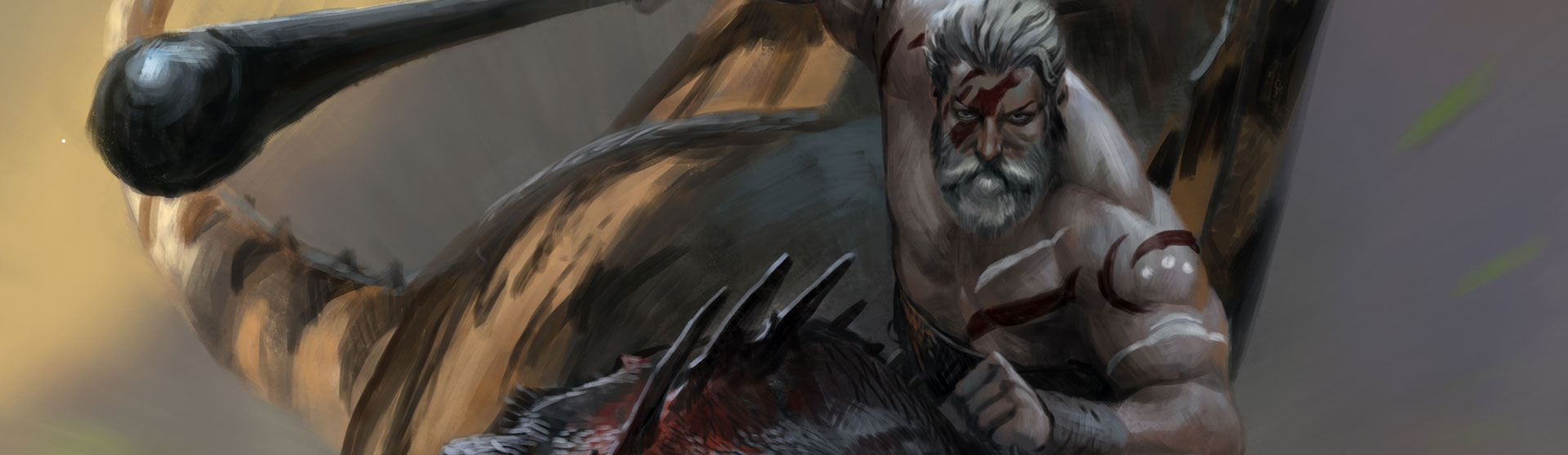
The fight continued on. The centaur leading the enemy cavalry broke through the villager line and slew three in a single charge. The orcs from the south approach were cut down by the manor guards. The worg riders tried maneuvering around the caltrop line and approached from the north. The Umbara, Brosena, and the manor guards took down the centaur vanguard. Our strategy was falling apart and the soil was saturated with the consequences.
As the goblinkin archers retreated from the other side of the roof, I saw a worg rider confront Sir Fel. This beast of a man, for he wore the hides and furs of beasts indeed, seemed to cleave villagers like farmers would through grain. Scrivener Merias launched bolts of flame, each more fervent (or desperate?) than the last to burn away the foe. He ended up getting the attention of nearly all of us as I lost track of the battlefield. Gradually, we wore him down, but he fought back with a berserk fury. Merias surely was furious, for his final bolt of flame had a distinctly azure hue and a choking black trail of smoke. This enhanced fire did the trick and felled the beastly man in a sulfurous fury.
I took sight of the square and counted who had died. We lost nineteen allies in total – eighteen villagers and one manor guard. Three manor guards were bleeding strongly of battle wounds, so I spent the last of my willpower to preserve and heal them. The Umbara kindly healed the third, then proceeded to coordinate the separation of the dead.
I saw Rose and our ally Dregs emerge from the south. Dregs appeared to be saturated entirely in sanguine, which he claimed was only partially his.
Everybody was colored sanguine in the square.
My heart began to slow and, with it, the pain in my arm flared to attention. I knew it needed to be cleaned, but also I needed to get out of this space. It was like Vulgan himself was gripping my chest and stopping my breath.
I called out to Sir Fil to help me tend to my shoulder as an excuse to step away. Brosena, showing compassion I hadn't seen yet from her (and out of fairness, in what circumstance would I have?), offered to heal my wound for me. I deflected, asking if anyone else needed it more and threw her attention and the bloodied Dregs.
With her ministries focused on her friend, Sir Fil took me to his smithery. No buildings seemed razed or torn asunder on the way (thank the spheres for small blessings), and so he helped undress, clean, then dress my wound.
I broke during this time. I killed, and I had never taken a life before. I knew I was training for warfare and combat, but that felt so far away. But there, on the spare cot in the hearth room, the reality of responsibility weighed heavily on me. I told Sir Fil of my troubles.
"I tried, Sir Fil. I fired my arrows, but I could not fire them fast enough. Villagers died in front of me, taking blows that I could have taken instead. I – I know that, if I took all those arrows, I would have fallen alongside them and they would still have died. I know this, and yet --" Sir Fil gave me a strip of leather to bite down on.
Sir Fil numbed my arm, then sharply pulled out the arrow without warning. I hissed through the pain, then nodded. He took the leather out of my mouth, then resumed to clean my shoulder wound.
"Pheatia's slap, that hurt. Uh, sorry." I stumbled over my words after slightly blaspheming, but he chuckled.
"Happens to all of us, son. What were you saying?"
"Right. Uh, I don't – I don't know how to say this right."
"There's no right way, only your true way."
"Okay." I was silent for a moment. "Sir Fil, that was the first time I killed anyone."
His hands paused as he flushed out my wound. His jaw tensed, then he resumed. "Is that so?"
"Yes sir. I knew I was trained to fight, and I had stories of glory and might to lead me forward. I know they romanticized the battlefield – that was taught fervently by Sir Donnel – but it is another thing to live through that. It feels … heavy. I feel heavy." I coughed as my chest filled with dark feelings. "I know that it was the best action I could have taken – Aen take me otherwise – and yet, that doesn't comfort."
"It never does," Sir Fil mumbled. "The weight should never feel light."
I looked at him, seeking out wisdom or experience in his eyes. All I saw was a hardened steel in his eyes. I knew Sir Fil was not blessed by a divine oath, nor carried a spark of magic in his blade. He was a soldier, a trained bannerman and knight. In that moment, the difference between him and the quiet assuredness of Sir Donnel was starkly clear.
"I … I am glad to hear that, Sir Fil. Truly. But in this moment, uh," I sniffed heavily. "I don't know. I fought and defended the homes of the innocent. I used all the tools I had at hand. I know that, but I do not feel that. What if I pushed for us to fight instead in streets? What if we barricaded the northern points? What if I insisted upon wearing armor, even when Sir Donnel said I wasn't ready yet? What if I practiced my magic more? What if –"
Sir Donnel started to wrap my arm but ceased my rambling with a warm gaze. "You cannot ask those questions, squire. You will never have answers and they will haunt you. From the little I've seen of you, I am confident you did what you could. Focus on that."
I was quiet as he wrapped my shoulder in bandage. The room blurred and swam before I realized I was openly weeping. In a quiet voice, I continued.
"I asked them to stand strong. I talked about Aen's nobility and the light. They felt fear and would have fled from that death trap if I didn't convince them to stay. They died because of me."
"Ithol, stop. They fought because their home was in danger. They chose to be there."
I struggled to form words and I admit I cannot remember what I said next.
Sir Fil helmed me with my shirt, then helped me put back on my leather cuirass. "It is not your fault, Ithol."
I nodded, but my heart didn't agree. "Thank you, Sir Fil. I should return and sing a dirge or keening. My words brought kept them there, so maybe my voice can bring them comfort. It's what I'm good at – a show."
I weakly smiled, or so I tried, then left to go back to the square. There, I saw the dead separated – our dead were laid in neat rows with canvas sheets over them. Their dead were heaped together roughly.
The priestess Asé, her brother the scrivener Merias, and the headsmen Cind Llain emerged from the town hall not long after, which drew the crowd of survivors. I whispered to the priestess about how I was willing and able to singe a dirge in the faith of the spheres and in honoring of the elven spirits. She thanked me and asked me to perform soon.
She addressed the assembled villagers and spoke of their bravery and the bravery of the fallen, but I could see in the waters of her eyes and hear in the shake of her voice that she was close to collapsing under the grief. She gestured for me to begin the dirge, and so I did.
I strapped my olive-wood travel harp to my body and played a few base chords. The repeating pattern droned on, drawing the attention to me. And so, I sang, sliding between vulgar celestial (I knew the poems but not the language), elvish, and the common tongue. Roughly translated, I sang, honoring Thuses and Ilyric Silverdream. I tried to honor those who died while also keeping the village's hearts reminded that, tomorrow, dawn will come again.
I felt the dirge overwhelm me in the verses of the fallen's lament.
My fingers were callous and strong, but I felt pain nonetheless. I knew it was not my harp, but the spirit of the dirge. I felt my heart lift to heavenly heights as I sang and, as I performed, I heard the grief and pain of the village. In front of me laid seventeen people who left a painful void behind them, and I felt, at that moment, the terror of the fallen's worlds of experience being lost.
The village's survivors cried out. My performance took in their wails and lamentations, folding it into the song as it was meant to do. Their hearts were laid bare before the gods and I sheltered them as best I could.
My dirge came to an end, and I hung my head. The priestess resumed her service, then began the precession of the dead. I followed along, tore my right sleeve in grief, and watched as they were buried to the north.
I eventually made my way back to Sir Fil, where I paid little attention. I washed off the dried blood, undressed, and fell promptly to sleep. I never felt so tired before.
---
¹ Lyrics sourced from Michael McGlynn in his song One Last Song, slightly adjusted to fit closer to Caanae's setting.
The fight that followed felt like it took years and mere blinks of my life. We were out-maneuvered again by goblinkin on the rooftops to our east, so I focused on cover fire. Few of us had any ranged capabilities in combat, especially with the swell of our ranks being villagers who barely knew how to wield a club. I watched as over half a dozen villagers charged the goblinkin archers I was fighting and fell to their arrows. I managed to avoid a few, taking cover around the corner of a building (I think it was a bakery?), my feet slick on their blood.
I tried firing illuminated arrows, and at first I floundered greatly. My arrow curved and veered off course so far that it acted more like a signal light than an assault. I kept the rhythm of Dame Róisín in my heart and on my voice and I found my shots firing more true. Arrow after arrow was launched, my left shoulder burning from what appeared to be an orkish arrow still stuck in me. My left hand was growing slick with my own blood.
I heard the peals of divine bells to the south of me and the hesitant chanting of Rose. I didn't know she was gods-favored as a cleric or some other blessed, but then was not the time to interrogate such a thing. Based on how she described herself, I did not know how much was truly known by her either.
The fight continued on. The centaur leading the enemy cavalry broke through the villager line and slew three in a single charge. The orcs from the south approach were cut down by the manor guards. The worg riders tried maneuvering around the caltrop line and approached from the north. The Umbara, Brosena, and the manor guards took down the centaur vanguard. Our strategy was falling apart and the soil was saturated with the consequences.
As the goblinkin archers retreated from the other side of the roof, I saw a worg rider confront Sir Fel. This beast of a man, for he wore the hides and furs of beasts indeed, seemed to cleave villagers like farmers would through grain. Scrivener Merias launched bolts of flame, each more fervent (or desperate?) than the last to burn away the foe. He ended up getting the attention of nearly all of us as I lost track of the battlefield. Gradually, we wore him down, but he fought back with a berserk fury. Merias surely was furious, for his final bolt of flame had a distinctly azure hue and a choking black trail of smoke. This enhanced fire did the trick and felled the beastly man in a sulfurous fury.
I took sight of the square and counted who had died. We lost nineteen allies in total – eighteen villagers and one manor guard. Three manor guards were bleeding strongly of battle wounds, so I spent the last of my willpower to preserve and heal them. The Umbara kindly healed the third, then proceeded to coordinate the separation of the dead.
I saw Rose and our ally Dregs emerge from the south. Dregs appeared to be saturated entirely in sanguine, which he claimed was only partially his.
Everybody was colored sanguine in the square.
My heart began to slow and, with it, the pain in my arm flared to attention. I knew it needed to be cleaned, but also I needed to get out of this space. It was like Vulgan himself was gripping my chest and stopping my breath.
I called out to Sir Fil to help me tend to my shoulder as an excuse to step away. Brosena, showing compassion I hadn't seen yet from her (and out of fairness, in what circumstance would I have?), offered to heal my wound for me. I deflected, asking if anyone else needed it more and threw her attention and the bloodied Dregs.
With her ministries focused on her friend, Sir Fil took me to his smithery. No buildings seemed razed or torn asunder on the way (thank the spheres for small blessings), and so he helped undress, clean, then dress my wound.
I broke during this time. I killed, and I had never taken a life before. I knew I was training for warfare and combat, but that felt so far away. But there, on the spare cot in the hearth room, the reality of responsibility weighed heavily on me. I told Sir Fil of my troubles.
"I tried, Sir Fil. I fired my arrows, but I could not fire them fast enough. Villagers died in front of me, taking blows that I could have taken instead. I – I know that, if I took all those arrows, I would have fallen alongside them and they would still have died. I know this, and yet --" Sir Fil gave me a strip of leather to bite down on.
Sir Fil numbed my arm, then sharply pulled out the arrow without warning. I hissed through the pain, then nodded. He took the leather out of my mouth, then resumed to clean my shoulder wound.
"Pheatia's slap, that hurt. Uh, sorry." I stumbled over my words after slightly blaspheming, but he chuckled.
"Happens to all of us, son. What were you saying?"
"Right. Uh, I don't – I don't know how to say this right."
"There's no right way, only your true way."
"Okay." I was silent for a moment. "Sir Fil, that was the first time I killed anyone."
His hands paused as he flushed out my wound. His jaw tensed, then he resumed. "Is that so?"
"Yes sir. I knew I was trained to fight, and I had stories of glory and might to lead me forward. I know they romanticized the battlefield – that was taught fervently by Sir Donnel – but it is another thing to live through that. It feels … heavy. I feel heavy." I coughed as my chest filled with dark feelings. "I know that it was the best action I could have taken – Aen take me otherwise – and yet, that doesn't comfort."
"It never does," Sir Fil mumbled. "The weight should never feel light."
I looked at him, seeking out wisdom or experience in his eyes. All I saw was a hardened steel in his eyes. I knew Sir Fil was not blessed by a divine oath, nor carried a spark of magic in his blade. He was a soldier, a trained bannerman and knight. In that moment, the difference between him and the quiet assuredness of Sir Donnel was starkly clear.
"I … I am glad to hear that, Sir Fil. Truly. But in this moment, uh," I sniffed heavily. "I don't know. I fought and defended the homes of the innocent. I used all the tools I had at hand. I know that, but I do not feel that. What if I pushed for us to fight instead in streets? What if we barricaded the northern points? What if I insisted upon wearing armor, even when Sir Donnel said I wasn't ready yet? What if I practiced my magic more? What if –"
Sir Donnel started to wrap my arm but ceased my rambling with a warm gaze. "You cannot ask those questions, squire. You will never have answers and they will haunt you. From the little I've seen of you, I am confident you did what you could. Focus on that."
I was quiet as he wrapped my shoulder in bandage. The room blurred and swam before I realized I was openly weeping. In a quiet voice, I continued.
"I asked them to stand strong. I talked about Aen's nobility and the light. They felt fear and would have fled from that death trap if I didn't convince them to stay. They died because of me."
"Ithol, stop. They fought because their home was in danger. They chose to be there."
I struggled to form words and I admit I cannot remember what I said next.
Sir Fil helmed me with my shirt, then helped me put back on my leather cuirass. "It is not your fault, Ithol."
I nodded, but my heart didn't agree. "Thank you, Sir Fil. I should return and sing a dirge or keening. My words brought kept them there, so maybe my voice can bring them comfort. It's what I'm good at – a show."
I weakly smiled, or so I tried, then left to go back to the square. There, I saw the dead separated – our dead were laid in neat rows with canvas sheets over them. Their dead were heaped together roughly.
The priestess Asé, her brother the scrivener Merias, and the headsmen Cind Llain emerged from the town hall not long after, which drew the crowd of survivors. I whispered to the priestess about how I was willing and able to singe a dirge in the faith of the spheres and in honoring of the elven spirits. She thanked me and asked me to perform soon.
She addressed the assembled villagers and spoke of their bravery and the bravery of the fallen, but I could see in the waters of her eyes and hear in the shake of her voice that she was close to collapsing under the grief. She gestured for me to begin the dirge, and so I did.
I strapped my olive-wood travel harp to my body and played a few base chords. The repeating pattern droned on, drawing the attention to me. And so, I sang, sliding between vulgar celestial (I knew the poems but not the language), elvish, and the common tongue. Roughly translated, I sang, honoring Thuses and Ilyric Silverdream. I tried to honor those who died while also keeping the village's hearts reminded that, tomorrow, dawn will come again.
I felt the dirge overwhelm me in the verses of the fallen's lament.
Thuses, blessed be the lord of the slain, saw all.
His mercy, everpresent and eternal, reached out.
To him, the fallen cried out:
"Sing me one last song
That will carry me away
To the warm summer memory of home
And that old melody
Softly echoes on the breeze
To a pathway that I must walk alone
I have loved, I have lain
On the dewey morning fields
With a cloud of flower blossom in the air
So lay me down
I’m weary of the cries and distant bells
One last farewell
The time for endless sleep will come
Sing me one last song
As the evening shadows fall
From Ilos reaching from the West
Raise up one last glass
As I hear Thuses call
And an old song will carry me to rest
I have loved, I have lain
On the dewey morning fields
With a cloud of flower blossom in the air
So lay me down
I’m weary of the cries and distant bells
One last farewell."¹
And Thuses took them in, giving them the rest they deserved.
We honor the umbral lord and shower him our gratitude.
Tonight is his night of celebration.
But forget not tomorrow, for we are still here.
Ilos's dawn will rise again, and we must strive to stand in it.
Pheatia's peace will return again, and we must look forward to it.
Etonae's song will sing again, and we must remember it.
My fingers were callous and strong, but I felt pain nonetheless. I knew it was not my harp, but the spirit of the dirge. I felt my heart lift to heavenly heights as I sang and, as I performed, I heard the grief and pain of the village. In front of me laid seventeen people who left a painful void behind them, and I felt, at that moment, the terror of the fallen's worlds of experience being lost.
The village's survivors cried out. My performance took in their wails and lamentations, folding it into the song as it was meant to do. Their hearts were laid bare before the gods and I sheltered them as best I could.
My dirge came to an end, and I hung my head. The priestess resumed her service, then began the precession of the dead. I followed along, tore my right sleeve in grief, and watched as they were buried to the north.
I eventually made my way back to Sir Fil, where I paid little attention. I washed off the dried blood, undressed, and fell promptly to sleep. I never felt so tired before.
---
¹ Lyrics sourced from Michael McGlynn in his song One Last Song, slightly adjusted to fit closer to Caanae's setting.